
One of the most troubling things in any workplace happens when people stop complaining and it is now being classified and largely regarded as workplace fear and silence.
I recently came across a comment on Facebook that captured workplace fear and silence problem painfully.
One of my followers named Hon. Obadimu Olusola described a transportation-mobility survey they joined. The team expected basic welfare items for participants. These included jackets, head covers, nose covers and other protective equipment.
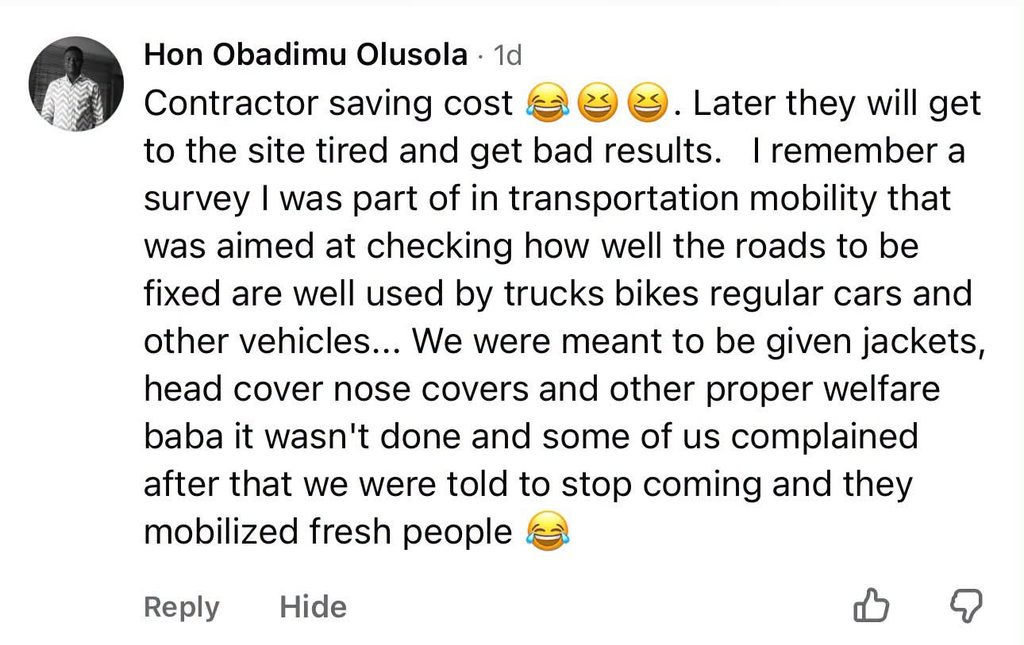
According to the account, the organisers did not provide those items.
Some participants complained about the situation. The response reportedly asked them to stop coming. The organisers then brought in fresh participants.
That story may look like one workplace experience. However, it points to a much deeper problem within our society.
When Silence Becomes a Survival Strategy
Many people have learnt to remain silent because speaking up can come with a price to pay and created a workplace fear and silence pattern.
A worker who questions poor treatment may attract an unwanted label. A civil servant who challenges an instruction may appear disloyal. Contractors may fear losing future opportunities.
Employees who report wrongdoing can also worry about their positions.
Over time, survival can become more important than speaking the truth.
That creates a dangerous culture.
People who should ask questions begin to protect their jobs. Those who should report wrongdoing begin to look away. Others simply say, “Abeg, make I no get problem.”
Eventually, silence becomes part of the system.
The problem goes beyond individual workplaces. It affects how institutions operate and how people relate to authority.
When People Become Afraid of Authority
A workplace should allow people to raise legitimate concerns without fear.
Unfortunately, some environments operate differently.
The person with authority may hold enormous power over those below them. That power can influence employment, contracts, promotions and access to opportunities.
The message can become painfully simple:
“If you don’t like it, others are waiting to take your place.”
Such an environment discourages honest feedback.
It also removes an important layer of accountability. People stop telling leaders when something goes wrong.
That silence can allow small problems to grow into institutional failures.
Workplace welfare therefore deserves more than administrative attention. It concerns dignity, safety, rights and the quality of our institutions.
What #ChinaInMyEyes Made Me Consider
My visits to China have made me think more deeply about these issues around workplace fear and silence.
Through my #ChinaInMyEyes compilations, I have tried to examine development beyond roads, buildings and impressive infrastructure.
The experience exposed me to conversations around discipline, public responsibility, poverty reduction and local development.
China has its own history, institutions and political context. Nigeria cannot simply copy another country’s system.
Still, every development experience offers lessons worth examining.
One lesson particularly interests me: public office should come with responsibility and personal discipline.
In Up and Out of Poverty, Xi Jinping discusses the importance of self-cultivation among public officials.
He describes being “clean” as acting with integrity and having nothing to hide. He associates being “prudent” with careful consideration in words and actions.
He also connects diligence with studying hard and doing one’s best to advance.
The principle matters beyond the person who expressed it.
Public office should demand integrity, responsibility and restraint.
It should never become a pathway to personal enrichment, intimidation or the creation of powerful cliques.
We Need Systems That Protect People
Nigeria needs stronger mechanisms for protecting people who raise legitimate concerns.
Such mechanisms should cover workplace welfare, safety, corruption, abuse and violations of established rights.
Government should consider strengthening existing agencies or creating effective independent structures where genuine gaps exist.
These institutions should do more than receive complaints.
They should investigate credible reports. They should protect whistleblowers where appropriate. They should enforce relevant standards.
Where officers or organisations violate established rules, appropriate sanctions should follow due process.
The question becomes important when the person receiving your complaint controls your employment.
What happens then?
Many people simply keep quiet.
When everyone keeps quiet, wrongdoing can become normal.
Public Service Must Remain Public
There is another side to this conversation.
Public servants should not see public office primarily as an opportunity for personal gain.
Neither should political connections determine who gets protection from accountability.
Institutions struggle when individuals form cliques around selfish interests. The situation becomes worse when those networks use public positions to advance private agendas.
Public service should remain centred on the public.
An office holder occupies a position temporarily. The institution should outlive the individual.
That understanding should influence every decision.
It should shape how officials treat workers. It should guide how they manage public resources. It should determine how they respond to criticism.
Most importantly, it should protect the right of people to disagree responsibly.
Development Is Also About How We Treat People
We often measure development through kilometres of roads, megawatts of electricity and completed projects.
Those indicators matter.
Yet development also concerns the everyday experience of people within our institutions.
What happens when someone says, “This isn’t right?”
Can that person speak without fear?
Can a worker request protective equipment without risking their livelihood?
Can a civil servant question an irregular instruction without becoming a target?
Can an employee report misconduct without facing retaliation?
Can public officers disagree professionally without creating camps?
These questions also belong in our development conversation.
A society where people fear speaking up may appear peaceful.
Sometimes, however, that silence simply reflects fear.
Silence should never become our definition of good governance.
The Culture We Need to Build
My #ChinaInMyEyes journey continues to remind me that development involves more than what we build.
It also concerns the systems behind those achievements.
It concerns the values that guide institutions. It concerns how leaders exercise authority. Most importantly, it concerns how institutions treat ordinary people.
Nigeria has talented people.
We have capable professionals and public servants who genuinely want to serve.
What we need is an institutional culture that gives them room to do the right thing.
We should create systems that encourage responsible criticism rather than punish it.
We should protect people who raise legitimate concerns rather than replace them simply because they spoke.
Leadership should not fear accountability.
Workers should not fear losing their jobs because they asked reasonable questions.
Public officers should not use their positions to build private empires.
People should not have to choose between keeping their jobs and speaking the truth.
That conversation deserves far more attention as we continue to build the Nigeria we want.

Again this is a good one.
Another angle to look at it is certainly, and almost communicated, which we term suffering and smiling (recently quit at the FM because of this).
This, in the long run, dampens creativity and commitment at work and causes fatigue even when the workload is not heavy, but just due to the fact that the worker’s welfare is not duly attended to.
This lack of creativity goes on to affect the economy of that ecosystem, and the effect progresses geometrically.
But then, these companies are aggressively profit-oriented and would take the most cruel capitalist approach.
It’s a sad world that will now require us to face ourselves and do what’s right by us in our own business or craft.